
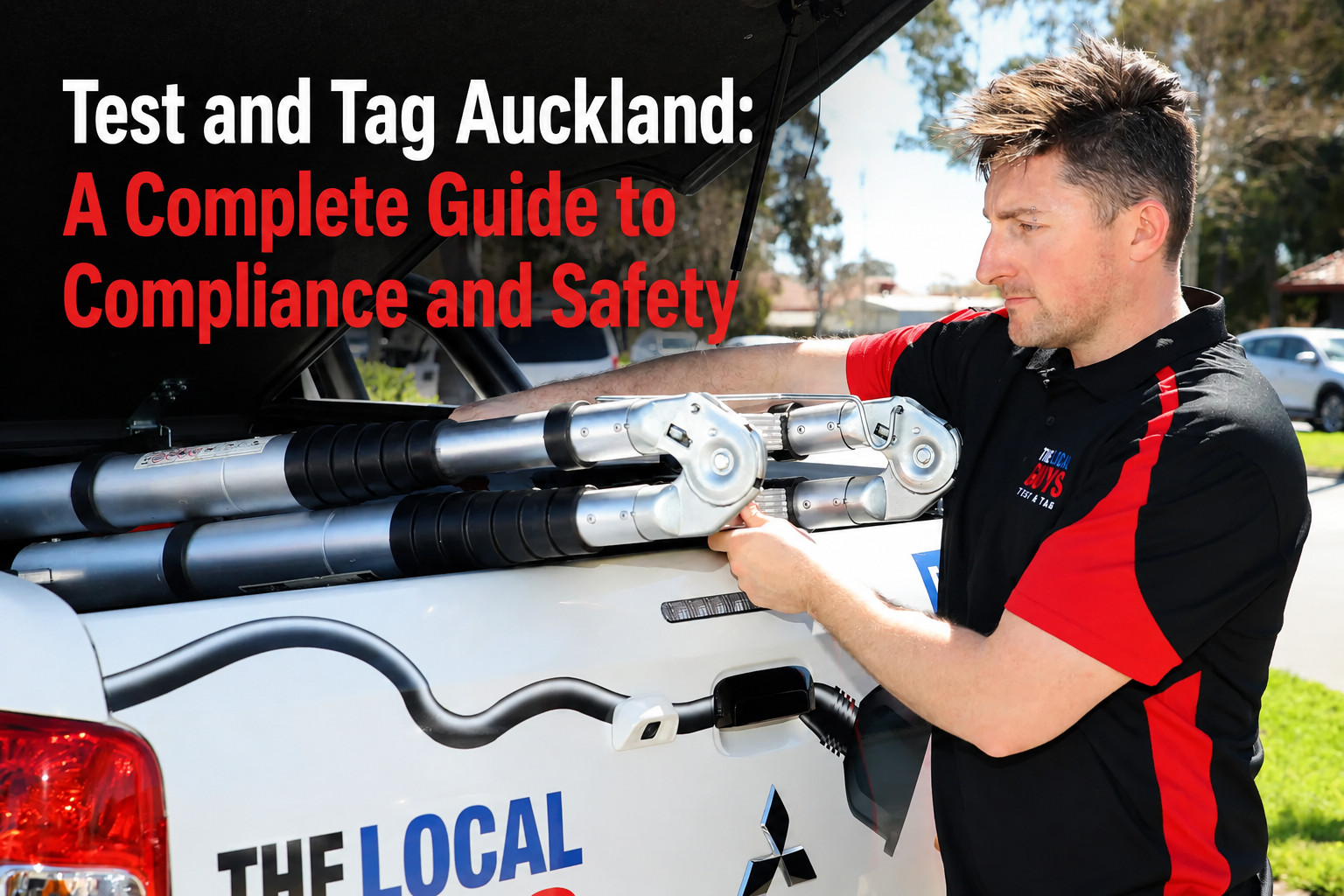
Auckland employers are required under the Health and Safety at Work Act 2015 to keep workplace electrical equipment safe, and AS/NZS 3760:2022 sets the standard for how that safety is tested and recorded. As the PCBU, you are responsible for having equipment inspected by a competent person, keeping test records, and following the testing interval that matches your work environment. This guide covers what the standard requires, how often testing needs to happen, and what a compliant test and tag process looks like for an Auckland business.
Understanding Electrical Safety in the Auckland Workplace
Why Test and Tag is Essential for Workplace Safety
Workplace safety in New Zealand is predicated on the proactive identification and elimination of hazards. Electrical equipment—ranging from high-powered industrial drills to mundane office kettles is subject to wear and tear. Over time, internal components degrade, insulation fails, and grounding becomes compromised. "test and tag services in Auckland" serves as the primary diagnostic tool to identify these invisible risks. By performing rigorous electrical inspections, businesses ensure that equipment remains safe for use, significantly reducing the probability of accidents that could result in injury or downtime.
The Role of WorkSafe NZ and New Zealand Legislation
WorkSafe New Zealand provides the regulatory framework that governs workplace health and safety. Under the Health and Safety at Work Act 2015, the responsibility for maintaining a safe environment is non-negotiable. While the legislation itself sets the broad principles of "reasonably practicable" safety measures, it relies on established standards to define what those measures look like. Compliance is not optional; it is a fundamental requirement for anyone operating a business in New Zealand.
PCBU Responsibilities Under the Health and Safety at Work Act
 A breakdown of PCBU responsibilities and the potential legal and safety consequences of failing to maintain electrical compliance.
A Person Conducting a Business or Undertaking (PCBU) bears the ultimate responsibility for the safety of workers and others in the workplace. If an electrical accident occurs because equipment was not properly maintained, the PCBU can be held liable. This includes ensuring that all electrical appliances are inspected by a "competent person" and that records are maintained. Ignoring these responsibilities can lead to heavy fines, potential prosecution, and, most critically, the loss of life or property.
The New Zealand Standard: AS/NZS 3760:2022 Explained
Key Updates in the AS/NZS 3760:2022 Revision
The AS/NZS 3760:2022 standard is the benchmark for the in-service safety inspection and testing of electrical equipment. The recent updates to this standard emphasize a risk-based approach, moving away from rigid, one-size-fits-all schedules. It clarifies the requirements for testing frequencies based on environmental factors and the level of risk associated with specific equipment usage. Staying current with these changes is essential for any Auckland business looking to maintain genuine compliance.
Understanding AS/NZS 3012 for Construction and Demolition Sites
While AS/NZS 3760 covers general workplaces, construction and demolition sites are governed by the more stringent AS/NZS 3012. These environments involve harsh conditions, frequent movement of equipment, and high moisture levels, which significantly accelerate the deterioration of electrical cords and tools. Testing intervals in these settings are notably shorter to account for the heightened risk of physical damage.
The Consequences of Non-Compliance: Liability and Fire Hazards
Non-compliance is a dangerous gamble. Insurance providers often mandate proof of testing as a prerequisite for coverage. If a fire starts due to a faulty extension cord that hadn't been tested in two years, your claim may be denied. Beyond insurance, the legal consequences include significant penalties under the Health and Safety at Work Act, with fines ranging into the tens of thousands of dollars, depending on the severity of the incident.
What Does a Professional Test and Tag Process Involve?
Step 1: Comprehensive Visual Inspection (Plugs, Cords, and Casings)
The process begins with a meticulous visual check. A professional inspector looks for obvious signs of damage, such as cuts in the insulation, exposed wiring, loose plugs, or cracked casing. Often, a physical flaw is detectable long before an electrical fault manifests.
Step 2: Electrical Testing (Earth Continuity and Insulation Resistance)
Once the visual inspection is cleared, electrical testers verify the equipment’s internal integrity. This includes checking earth continuity—ensuring that the protective earth path is intact—and testing insulation resistance to ensure no current is leaking from the internal wiring to the external casing.
Step 3: Polarity Checks and RCD (Safety Switch) Testing
For equipment with active components, polarity testing ensures that live and neutral wires are correctly connected. Additionally, Residual Current Device (RCD) testing is critical. RCDs are designed to trip instantly if an imbalance in current is detected, preventing fatal shocks. Testing these devices ensures they remain functional when they are needed most.
Step 4: Tagging, Hazard Isolation, and Reporting
After successful testing, a durable tag is applied to the item, showing the date of the test and the next due date. If an item fails, it is immediately removed from service, tagged as "failed," and the owner is notified to prevent accidental use. A comprehensive report is then generated, serving as an official record for compliance audits.
Essential Equipment That Requires Regular Testing
Portable Electrical Appliances and Power Tools
From standard office equipment like computers and monitors to heavy-duty power tools in workshops, any appliance with a flexible cord and a plug should be treated as a potential hazard. Frequent handling of tools in Auckland’s diverse industrial sectors necessitates regular checking.
Extension Leads, Power Boards, and Flexible Cords
Extension leads are among the most frequently abused electrical items. Because they are often tripped over, crushed, or coiled incorrectly, their internal structure often breaks down. These items require diligent inspection to ensure they don't become fire starters.
Kitchen Appliances: Microwaves and Coffee Machines
Breakroom appliances are high-usage, high-risk items. The combination of heat, frequent switching, and proximity to moisture makes kettles, microwaves, and coffee machines prime candidates for electrical faults. These should be included in every regular testing cycle.
3-Phase Equipment and Heavy Industrial Machinery
Industrial machinery, including 3-phase equipment, presents greater electrical hazards than standard single-phase household appliances. Testing this equipment requires specialized knowledge and equipment, underscoring the need for a professional service provider.
Tailoring Compliance to Auckland’s Diverse Industries
Construction Sites: Managing Rugged Environments and Damp Conditions
Auckland’s construction industry operates in a challenging climate. High humidity and damp conditions exacerbate corrosion. On these sites, daily visual checks combined with frequent formal testing are essential to manage the elevated risk profile of site-based equipment.
Office and Commercial Spaces: Protecting IT Infrastructure and Staff
Offices may seem low-risk, but they are often filled with daisy-chained power boards and ageing cables hidden under desks. A professional test and tag service helps manage these "hidden" hazards, ensuring that staff are protected and that valuable IT infrastructure isn't compromised by electrical surges.
Hospitality and Retail: High-Usage and Public-Facing Equipment
In retail and hospitality, equipment is subjected to intensive use by staff and, occasionally, the public. Maintaining compliance here is not just a safety duty; it is a matter of business continuity. An unexpected equipment failure during a busy shift can halt operations entirely.
Education and Healthcare: Ensuring Safety for Vulnerable Occupants
Schools and medical facilities demand the highest standards of safety. Given that these environments house vulnerable occupants, the frequency of testing should be proactive, often exceeding the minimum requirements to provide an extra layer of assurance.
Determining Your Testing Frequency: How Often is Enough?
Understanding the Testing Intervals (3, 6, 12, and 24 Months)
Testing intervals are determined by the risk profile of the environment. High-risk areas like construction sites often require 3-monthly testing. Commercial offices might only need testing every 12 to 24 months. Identifying your specific interval requires a risk assessment of your site.
Factors That Influence Testing Schedules (Environment vs. Usage)
The environment is the greatest factor in determining your schedule. If equipment is used in a harsh, industrial, or damp environment, the interval between tests must be shorter. If the equipment is used in a stable, climate-controlled office, the risk is lower, and the schedule can be extended.
Managing Automated Reminders to Ensure Continuous Compliance
The most common cause of non-compliance is simply forgetting when the next test is due. Implementing an automated system or partnering with a professional service that provides reminders is the most reliable way to maintain consistent compliance without the stress of manual tracking.
Beyond the Tag: Modern Asset Management and Digital Reporting
The Shift from Paper Records to Searchable Digital Databases
The days of manual paper logs are fading. Modern compliance management involves digital asset registers that provide real-time visibility into your inventory. Digital databases allow business owners to track the history of every appliance, see when testing is due, and provide instant proof of compliance during a WorkSafe inspection.
Conclusion
Electrical safety is an ongoing commitment to the well-being of your staff and the sustainability of your business. By moving beyond a simple "tick-box" mentality and viewing test and tag as an integral part of your asset management strategy, you protect your company from significant legal and financial risks.
In the competitive landscape of Auckland, businesses that prioritize safety stand out as reliable and professional. Whether you are managing a busy construction site or an office complex, the process remains the same: identify your risks, adhere to the AS/NZS 3760:2022 standards, and maintain clear records of your compliance journey.
If you are unsure of your current compliance status, the best next step is to schedule a comprehensive electrical audit. Engaging a professional who utilizes modern, digital reporting tools will not only ensure your equipment is safe today but will also provide a clear, automated roadmap for your future testing needs. Do not wait for a component to fail; prioritize the electrical integrity of your workplace now to ensure the safety and continuity of your operations in the long term.

