
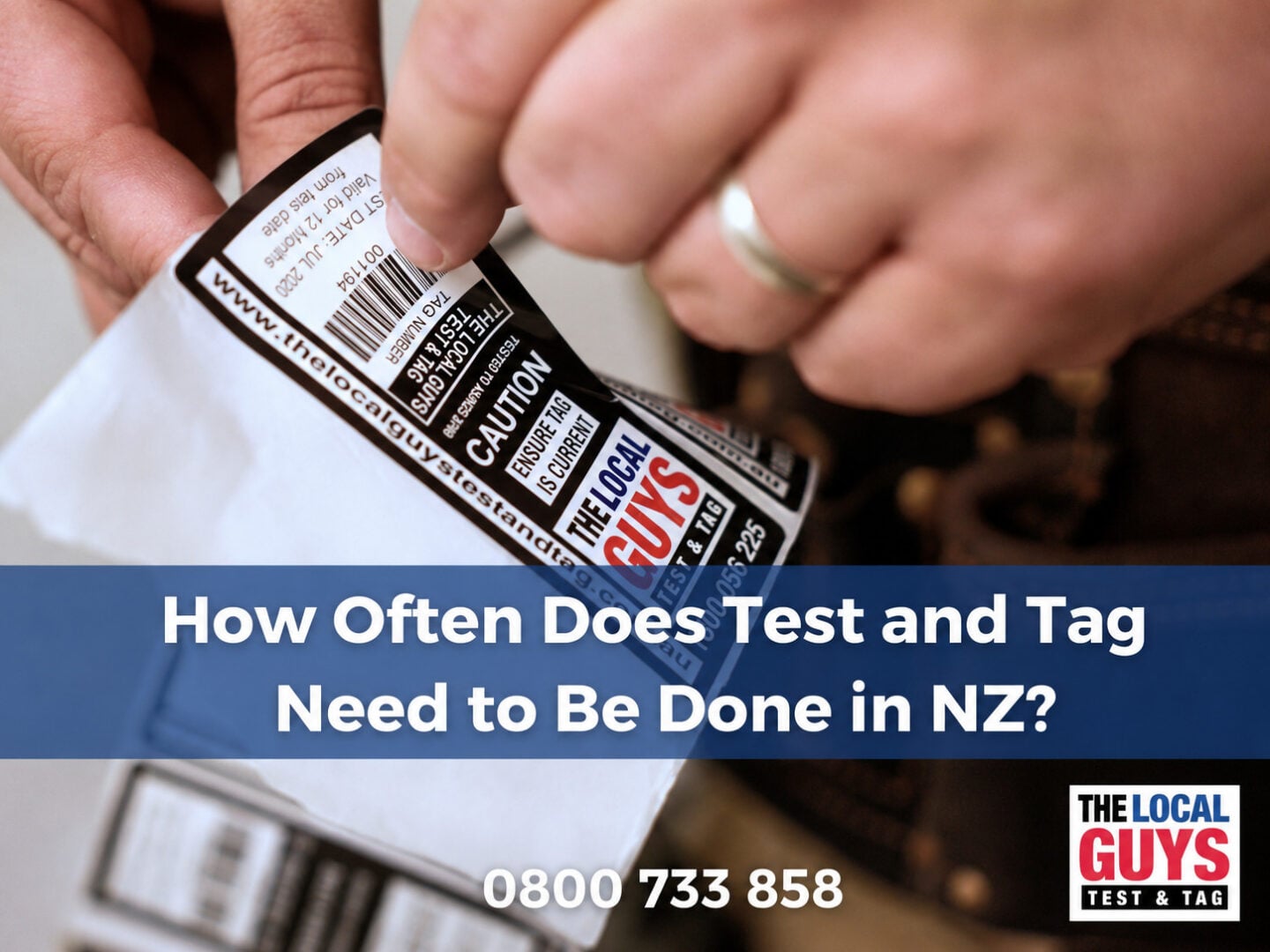
If you're a business owner or health and safety manager in New Zealand, one of the most common questions you'll face is how often your electrical appliances actually need to be tested and tagged.
The answer depends on where and how your equipment is used. Under the AS/NZS 3760:2022 standard, the current New Zealand standard for in-service safety inspection and testing of electrical equipment, testing intervals are set according to the risk environment your appliances operate in. A power drill on a construction site faces very different risks than a kettle in an office kitchen, and the standard reflects that.
This guide covers every testing interval required under AS/NZS 3760:2022, what environments they apply to, and what your obligations are as a New Zealand employer under the Health and Safety at Work Act 2015.
The AS/NZS 3760:2022 Testing Frequency Intervals
AS/NZS 3760:2022 defines four testing intervals based on environment type.
Every 3 Months — Construction, Building and Demolition
The most frequent interval applies to equipment used on construction, building, and demolition sites. These environments expose electrical equipment to the harshest conditions: physical impact, moisture, dust, heat, and constant movement. A damaged cord or faulty connection in this setting creates immediate risk of electric shock or fire.
Equipment in this category includes angle grinders, circular saws and power drills, extension leads and portable power boards on site, portable lighting and heating equipment, and any appliance used outdoors or in uncontrolled environments. If your business operates on building sites anywhere in New Zealand, every portable electrical appliance must be inspected and tested at a maximum of three-monthly intervals.
Every 6 Months — Factories, Production and Warehouses
The six-month interval applies to manufacturing, production, and warehouse environments, places where equipment is used intensively but in more controlled conditions than an active construction site. Equipment in factories and warehouses still faces significant wear from vibration, repeated use, and exposure to industrial substances. Six-monthly testing ensures faults are caught before they become hazards.
This covers production line machinery and tools, portable appliances in manufacturing facilities, equipment in food processing environments, and warehouse power tools and charging equipment.
Every 12 Months — Schools, Offices and Office Kitchens
The 12-month interval covers environments where equipment is subject to flexing cords or potential abuse, but in less hazardous settings than industrial workplaces. This is the interval that applies to most standard commercial environments in New Zealand: office buildings and co-working spaces, schools and educational facilities, retail environments, office kitchens and break rooms, and hotel and accommodation facilities.
The key factor here is whether cords are regularly flexed or moved. A laptop power adaptor that sits on a desk all day still falls into this category because it is handled regularly by users.
Every 5 Years — Server Rooms and Low-Use Environments
The longest interval applies to equipment that is not prone to flexing and is not subject to abuse, essentially equipment that is fixed in place and rarely handled. This typically covers server room and data centre equipment, fixed IT infrastructure, and equipment that is permanently installed or rarely moved.
It is important to note that this five-year interval only applies where these specific conditions are genuinely met. If there is any doubt about whether equipment qualifies, default to the 12-month interval.
Summary: NZ Test and Tag Frequency Table
| Interval | Environment |
|---|---|
| 3 Months | Construction, building and demolition |
| 6 Months | Factories, production and warehouse |
| 12 Months | Schools, offices, office kitchens (equipment prone to flexing or abuse) |
| 5 Years | Server rooms (equipment not prone to flexing, not open to abuse) |
Source: AS/NZS 3760:2022, as referenced at standards.govt.nz
Mixed Environments: What Applies to You?
Many New Zealand businesses operate across multiple environment types. A company with both office staff and a warehouse needs to apply different testing frequencies to equipment in each area. The correct approach is to classify each appliance based on where it is primarily used, not by the overall nature of the business. A laptop in the head office of a construction company is tested annually. A power tool that goes to site every day is tested every three months.
If you're unsure how to classify specific appliances, a qualified test and tag technician can help you set up an appropriate testing schedule that meets AS/NZS 3760:2022 requirements without over-testing low-risk equipment or under-testing high-risk items.
Does NZ Law Require Test and Tag?
The Health and Safety at Work Act 2015 (HSWA) requires New Zealand businesses to eliminate or minimise risks to workers so far as is reasonably practicable. While HSWA does not prescribe specific testing intervals for electrical appliances by name, AS/NZS 3760:2022 is the recognised standard for demonstrating that electrical safety obligations are being met.
In practice, following AS/NZS 3760:2022 intervals is the standard way to show due diligence under HSWA. WorkSafe NZ can reference compliance with the standard during investigations or audits, and businesses that cannot demonstrate regular testing face significant legal and financial exposure if an electrical incident occurs.
For a full breakdown of the legal picture, see our guide: Is Test and Tag a Legal Requirement in New Zealand?
What Needs to Be Tested?
Under AS/NZS 3760:2022, testing applies to portable and transportable electrical equipment, that is, equipment that is plugged into a general-purpose outlet and can be moved. This includes power tools and hand tools, extension leads and power boards, kitchen appliances in commercial settings, IT equipment such as computers, monitors and printers, portable heaters and fans, cleaning equipment like vacuums and floor polishers, and audio-visual equipment.
Fixed wiring and hardwired equipment are outside the scope of AS/NZS 3760:2022 and fall under different compliance requirements.
What Does Test and Tag Actually Involve?
A test and tag inspection involves two components. The first is a visual inspection, where a qualified technician checks the appliance, cord, and plug for visible signs of damage, wear, or unsafe modification. Many faults are identifiable visually before any electrical test is needed.
The second is electrical testing, where calibrated testing equipment is used to measure insulation resistance, earth continuity (for Class I equipment), and other parameters specified in AS/NZS 3760:2022. If the appliance passes, it receives a tag showing the test date, next test date, and the technician's details. If it fails, it is removed from service immediately.
Compliance reports and certificates are provided after each testing session, giving you a documented record of compliance for WorkSafe NZ purposes.
To learn more about our portable appliance testing service, visit our services page.
Automated Compliance Reminders
One of the most common compliance failures is not skipping testing entirely but losing track of when the next test is due. When you're managing dozens or hundreds of appliances across different intervals, due dates can easily slip. The Local Guys Test and Tag provides automated compliance reminders so you always know when your next inspection is approaching, without needing to track dates manually.
Get Your Test and Tag Scheduled
The Local Guys Test and Tag operates across New Zealand with locally based technicians in every region. We work to AS/NZS 3760:2022, provide compliance reports and certificates after every job, and cover all testing intervals from monthly construction site visits to annual office inspections.
Our technicians cover Auckland, Wellington, Christchurch, Hamilton, Tauranga, Dunedin, and all major New Zealand centres.
Request a Quote or call us anytime on 0800 733 858.
Frequently Asked Questions
How often does test and tag need to be done in NZ?
Under AS/NZS 3760:2022, the required interval depends on the work environment. Construction and demolition sites require testing every 3 months. Factories and warehouses require testing every 6 months. Offices, schools, and similar environments require testing every 12 months. Equipment not prone to flexing in low-risk environments such as server rooms may qualify for a 5-year interval.
Is there a legal requirement to test and tag in New Zealand?
The Health and Safety at Work Act 2015 requires businesses to manage electrical risks so far as is reasonably practicable. AS/NZS 3760:2022 is the accepted standard for demonstrating compliance. While the intervals are not named directly in legislation, following the standard is the recognised method of meeting your duty of care under HSWA.
What happens if I don't test and tag on time?
Failure to maintain current test and tag compliance creates risk of WorkSafe NZ enforcement action, insurance claim complications following an electrical incident, and personal liability for managers and business owners responsible for health and safety.
Who can carry out test and tag in New Zealand?
Testing must be carried out by a competent person, someone with the appropriate training, knowledge, and equipment to conduct in-service inspection and testing in accordance with AS/NZS 3760:2022. The Local Guys Test and Tag technicians are trained to this standard, carry police clearance checks, and provide full compliance documentation.
How long does a test and tag take?
Testing time depends on the number of appliances and the complexity of the site. A standard office with 50 to 100 items typically takes one to two hours. Larger sites with several hundred appliances may require a half or full day. Our technicians work efficiently to minimise disruption to your operations.
Does test and tag cover RCD safety switches?
No. RCD testing is a separate compliance requirement. RCDs protect against electric shock by detecting earth faults and cutting power quickly. They require their own periodic testing and should be completed alongside portable appliance testing. Learn more about our RCD safety switch testing service.

